


Disandra Prostrata
Flowers



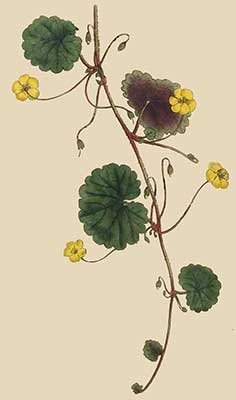
Disandra Prostrata
The foliage of this plant greatly resembles that of Ground Ivy, and its branches trail on the ground somewhat in the same manner, extending to the length of several feet, but it is not on the ground that it is best seen, as its flowers are apt to be hid among the leaves it appears most advantageously when growing in a pot, placed on a pedestal, or in some elevated situation, where its branches may hang carelessly down thus treated, when fully blown, it becomes a most pleasing object.Linn?us, the son, in his Suppl. Plant. observes, that the Disandra varies extremely in the number of its stamina, as it does also in the divisions of its calyx, and corolla, in this respect,, indeed, we do not know its equal fortunately for those systems of Botany, which are formed from the number of certain parts of the fructification, few such inconstants exist.Professor Murray observes, that seven is the most prevalent number of its stamina, five the most natural.Linn?us describes it as a native of the East, Mr. Aiton informs us, that it was introduced here about the year 1771, from Madeira.It flowers during most of the summer months, in the winter it must be kept in the green house, in the summer it will bear the open air, grows readily from cuttings, should be planted in rich earth, and plentifully watered in dry weather.

 Struthiola Erecta
 TRELITZIA REGINae
 Adonis Vernalis
 Rosa Semperflorens
 Kalmia Glauca
 Primula Marginata
 Geranium Striatum
 Lupinus Luteus
 Lopezia Racemosa
 Metrosideros Citrina
 Narcissus Angustifolius
 Geranium Reichardi Dwarf Geranium
 Test your English Language
  Tips to succeed in IELTS Exam
 Top High Speed Bullet Trains Rules to play Kayaking
 Precautions while using Induction Cooker Movie Plot Holes and Paradoxes Rules to play Baseball Beauty Skin Care Tips Baby Friendly Decorations Ideas Favourite Christmas Movies
 Precautions while using Securing Email Rules to play Synchronized Swimming How to prevent Hair Fall Rules to play Trampolining Hairstyles To Compliment Your Saree
 Most Popular Search Engines
 Prime Minister Of India Problems Only 00s Girls Will Understand
 Promise Day