


Sedum Populifolium
Flowers



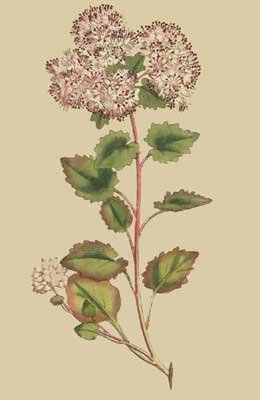
Sedum Populifolium
Professor Pallas, the celebrated Russian naturalist, discovered this species of Sedum in Siberia, and in the year 1780, introduced it to the royal garden at Kew, the younger Linn?us describes it minutely in his Suppl. Plantarum, and observes, that in its general form it much resembles the Saxifraga rotundifolia.Its leaves are flat as in many of the other species, and when the plant grows in an open situation, exposed to the sun, they become as well as the stalks of a bright red colour, which adds much to its beauty.It is the only hardy Sedum cultivated, in our gardens with a shrubby stalk, its leaves however are deciduous, so that in the winter it loses its verdure, it flowers in July and August, and is readily increased by cuttings.As most of this tribe grow readily, and many of them naturally on rocks and walls, they may be in general regarded as proper rock plants, some of them however are apt by the quickness of their growth to extend over and destroy plants of more value, this fault, if such it may be deemed, is not imputable to the populifolius.Some not knowing its native place of growth, keep it in the green house.

 Jasminum Officinale Common Jasmine or Jessamine
 Narcissus Bulbocodium
 Convolvulus Tricolor Small Convolvulus or Bindweed
 Iris Variegata Variegated Iris
 Allium Descendens
 Bulbocodium Vernum
 Ferraria Undulata
 Plumeria Rubra
 Lilium Chalcedonicum Chalcedonian Lily
 Viola Pedata
 Ixora Coccinea
 Erica Cerinthoides
 Test your English Language
  Finishing Moves In WWE Prosperous Countries In The World Superfoods To Boost Your Brainpower Naturally Tummy Toning Exercises
 Mountains in India Body Language
 Chinese New Year
 Tips to get ready for Study Largest Wrestlers in WWE History Worlds Most Bizarre People
 Delicious Cookie Recipes
 Most Popular Search Engines
 Major Dhyan Chand
 What to Eat in Jharkhand
 Precaution while using Contact Lenses Most Popular Animals Most Popular Apps Employees Use At Work Most Popular Cricketers Perpetually