


Tropaeolum Majus Greater Indian Cress or Nasturtium
Flowers



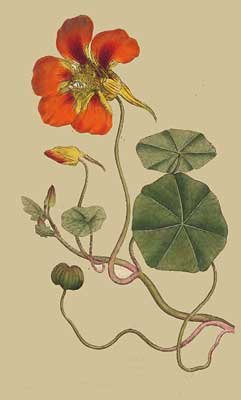
Tropaeolum Majus Greater Indian Cress or Nasturtium
The present plant is a native of Peru, and is said by Linnaeus to have been first brought into Europe in the year 1684, it is certainly one of the greatest ornaments the Flower Garden can boast it varies in colour, and is also found in the Nurseries with double flowers. The former, as is well known, is propagated by seed, the latter by cuttings, which should be struck on a hot bed. To have these plants early, they should be raised with other tender annuals, they usually begin to flower in July, and continue blossoming till the approach of winter the stalks require to be supported, for if left to themselves they trail on the ground, overspread, and destroy the neighbouring plants.
Elizabeth Christina, one of the daughters of Linnaeus, is said to have perceived the flowers to emit spontaneously, at certain intervals, sparks like those of electricity, visible only in the dusk of the evening, and which ceased when total darkness came on.
The flowers have the taste of water cress, with a degree of sweetness, which that plant does not possess, more particularly resident in the spur of the calyx or nectary, hence are sometimes used in sallads, and hence the plant acquires its name of Nasturtium.

 Myrtus Tomentosa
 Mesembryanthemum Bicolorum
 Lotus Jacobaeus
 Saponaria Ocymoides
 Cistus Ladaniferus
 Ranunculus Gramineus
 Ixora Coccinea
 Coronilla Glauca Sea green or Day smelling Coronilla
 Campanula Speculum
 Celsia Linearis
 Statice Sinuata
 Lathyrus Articulatus
 Test your English Language
  Wildlife Sanctuaries and National Parks of India
 Benefits of Cashew
 Cut Throat Pool Game Rules to play Snow Shoeing
 Precautions while using Power Supply Top Smartphones Makeup for Valentines Day White Henna Designs
 Benefits of Cauliflower The Worlds Highest Paid Athletes Rules to play Kickball Worlds Deadliest Martial Arts
 Precautions while using Pesticides
 Benefits of Jackfruits How to Maintain Good Hygiene Most Popular Animals Most Popular Apps Employees Use At Work Most Popular Cricketers Perpetually