


Laws of motion
Isaac Newton



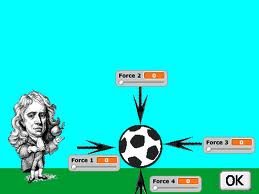
Laws of motion
In the Principia, Newton gives the famous three laws of motion, stated here in modern form.Newtons First Law (also known as the Law of Inertia) states that an object at rest tends to stay at rest and that an object in uniform motion tends to stay in uniform motion unless acted upon by a net external force. The meaning of this law is the existence of reference frames (called inertial frames) where objects not acted upon by forces move in uniform motion (in particular, they may be at rest).Newtons Second Law states that an applied force, mathbf{F}, on an object equals the rate of change of its momentum, mathbf{p}, with time. Mathematically, this is expressed asSince the law applies only to systems of constant mass, m can be brought out of the derivative operator. By substitution using the definition of acceleration, the equation can be written in the iconic formThe first and second laws represent a break with the physics of Aristotle, in which it was believed that a force was necessary in order to maintain motion. They state that a force is only needed in order to change an objects state of motion. The SI unit of force is the newton, named in Newtons honour.
Newtons Third Law states that for every action there is an equal and opposite reaction. This means that any force exerted onto an object has a counterpart force that is exerted in the opposite direction back onto the first object. A common example is of two ice skaters pushing against each other and sliding apart in opposite directions. Another example is the recoil of a firearm, in which the force propelling the bullet is exerted equally back onto the gun and is felt by the shooter. Since the objects in question do not necessarily have the same mass, the resulting acceleration of the two objects can be different (as in the case of firearm recoil).Unlike Aristotles, Newtons physics is meant to be universal. For example, the second law applies both to a planet and to a falling stone.The vector nature of the second law addresses the geometrical relationship between the direction of the force and the manner in which the objects momentum changes. Before Newton, it had typically been assumed that a planet orbiting the Sun would need a forward force to keep it moving. Newton showed instead that all that was needed was an inward attraction from the Sun. Even many decades after the publication of the Principia, this counterintuitive idea was not universally accepted, and many scientists preferred Descartes theory of vortices.

 Royal Mint
 Political Interference
 Publications
 Effect on religious thought
 Advanced early modern chemistry
 Optics
 Mathematics
 Introduction
 Nervous Breakdown
 Royal Opposition
 Early life
 light and color
 Test your English Language
  Tips to succeed in an Interview
 The Beautiful Brazil The Pool Gems Tips Tricks and Secrets Most Charming Alpine Towns Host a party
 Most Beautiful Mosques In The World How to Remove Dark Circles Tips Most Popular Apps Employees Use At Work Rainy Day Ideas
 Christmas Poems The worlds Fastest Limousine The Worlds Craziest Bar Concepts Most Obscure Sports In The World
 Largest Deserts of the World Ways to Get Happy
 Bollywood Hits Boost Self Confidence
 Boss Day