


The Kailasanatha temple
Ellora Caves



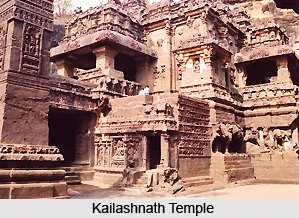
The Kailasanatha temple
Cave 16, also known as the Kailasa temple, is the unrivaled centerpiece of Ellora. This is designed to recall Mount Kailash, the abode of Lord Shiva looks like a freestanding, multi storeyed temple complex, but it was carved out of one single rock, and covers an area double the size of Parthenon in Athens. Initially the temple was covered with white plaster thus even more increasing the similarity to snow covered Mount Kailash.All the carvings are done in more than one level. A two storeyed gateway resembling a South Indian Gopura opens to reveal a U shaped courtyard. The courtyard is edged by columned galleries three storeys high. The galleries are punctuated by huge sculpted panels, and alcoves containing enormous sculptures of a variety of deities. Originally flying bridges of stone connected these galleries to central temple structures, but these have fallen.
Within the courtyard are three structures. As is traditional in Shiva temples, the first is a large image of the sacred bull Nandi in front of the central temple. The central temple Nandi Mantapa or Mandapa houses the Lingam. The Nandi Mandapa stands on 16 pillars and is 29.3 m high. The base of the Nandi Mandapa has been carved to suggest that life sized elephants are holding the structure aloft. A living rock bridge connects the Nandi Mandapa to the Shiva temple behind it. The temple itself is a tall pyramidal structure reminiscent of a South Indian Dravidian temple. The shrine complete with pillars, windows, inner and outer rooms, gathering halls, and an enormous lingam at its heart carved from living stone, is carved with niches, pilasters, windows as well as images of deities, mithunas (erotic male and female figures) and other figures. Most of the deities at the left of the entrance are Shaivaite (followers of Shiva) while on the right hand side the deities are Vaishnavaites (followers of Vishnu). There are two Dhvajastambhas (pillars with the flagstaff) in the courtyard. The grand sculpture of Ravana attempting to lift Mount Kailasa, the abode of Lord Shiva, with his full might is a landmark in Indian art. The construction of this cave was a feat of human genius it entailed the removal of 200,000 tonnes of rock, and took 100 years to complete. The temple is a splendid achievement of Rashtrakuta Karnata architecture. This project was started by Krishna I (757773) of the Rashtrakuta dynasty that ruled from Manyakheta in present day Karnataka state. His rule had also spread to southern India, hence this temple was excavated in the prevailing style. Its builders modelled it on the lines of the Virupaksha Temple in Pattadakal. Being a south Indian style temple, it does not have a shikhara common to north Indian temples. The Guide to the Architecture of the Indian Subcontinent, 1996, Takeo Kamiya, Japan Architects Academy and archaeological Survey of India.

 Geology of Ellora
 The Buddhist caves
 The Jain caves
 The Dashavatara
 When to visit
 The Indra Sabha
 How to Reach Ellora by Flight
 Who build
 How to Reach Ellora by Rail
 Inscriptions at Ellora
 Best Time to Visit
 Location
 Test your English Language
  Table Etiquettes
 Jumping Jacks
Least Expensive New Cars of 2015
Jumping Jacks
Least Expensive New Cars of 2015 Benefits of Hair Straightening
 Healthy Neck
 Vasant Panchami
 Benefits of Kiwi Fruits
 Healthy Brow Rules to play Kite Flying
 Precautions while using Computer and Laptops Exam Tips
 Tips to Protect Your Heart
 Latest New Cars Largest Zoos in the World
 Benefits of Broccoli
 Photography Essentials
 Pink Lakes of the World Places to Go in the Last 17 Weeks of 2015