


Cytisus Laburnum
Flowers



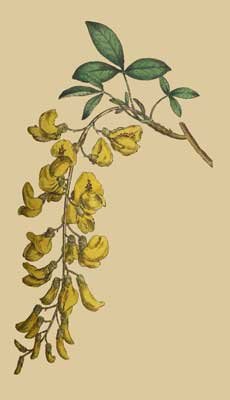
Cytisus Laburnum
Of the Laburnum, our nurseries afford two principal varieties, the broad and narrow leavd, the latter (which is the one here figured) Mr. Miller was induced to make a species of under the name of alpinum, it certainly differs very materially from the broad leavd one, yet is most probably only a seminal variety, the Laburnum figured in its wild state by Professor Jacquin, in his Flora Austriaca, has much broader leaves than ours, no mention is made by him of its being subject to vary.Both Miller and Hanbury recommend the Laburnum to be cultivated not only as an ornamental but as a timber tree, the wood having a very close grain, a good colour, and bearing a high polish,[6] they urge in its favour, that it is very hardy, a quick grower, and one that will thrive in almost any soil, the latter says, it will become a timber tree of more than a yard in girt whatever success may attend its cultivation for the more useful purposes, as a hardy, deciduous, ornamental tree, it has long been the pride of our shrubberies and plantations.It blossoms in May, and is usually very productive of seeds, by which it may be propagated most readily.Hares and rabbits being fond of its bark, do great damage to plantations of Laburnum, especially in severe weather, I remember somewhere to have read, that these animals will not touch a tree if soot has been placed about it, perhaps, a circle drawn round the base of the tree with the new coal tar, which has a powerful smell of long duration, might keep off these noxious animals.
The Professor does not mention the precise height which he had observed these trees to attain in North America, but it is evident that they acquire a considerable thickness, as the wood of the root as well as the body of the tree is manufactured into various utensils by the natives, and by the Indians into spoons in particular, whence it has obtained the name of the Spoon Tree.The leaves have been found to prove poisonous to kine, horses, and sheep, but the deer are observed to brouse on them with impunity.Peter Collinson, Esq. who was highly instrumental in enriching this country with the native plants of North America, is said to have introduced this elegant species about the year 1734.With us it succeeds best when planted with a northern aspect, well sheltered, in a soil composed of loam and bog earth, in a situation moderately moist, where the air is perfectly pure.Being with difficulty propagated by suckers or layers, it is most commonly raised from American seeds.

 Hyacinthus Racemosus
 Celsia Linearis
 Geranium Anemonefolium
 Tradescantia Virginica
 Epidendrum Cochleatum
 Limodorum Tuberosum
 Hyacinthus Botryoides
 Passiflora Ciliata
 Plumeria Rubra
 Buddlea Globosa
 Spigelia Marilandica
 Geranium Lanceolatum
 Test your English Language
  Favourite Christmas Movies Shopping Malls
 Major Wars Of 20th Century
 Benefits of Beetroot
 Latest New Cars
 Benefits of Apricots
 Teddy Day Amazing Natural Places in the World
 Benefits of Plum
 Mythological Creatures and Shapeshifters
 Mother Teresa How to Maintain Good Hygiene The Summer Vacation Tips Ways to Overcome Anger Best Shaded Mehndi Designs Most Obscure Sports In The World Most Photogenic and breathtaking places in the world Most Player of the Match Award Winners in ODIs