


Spigelia Marilandica
Flowers



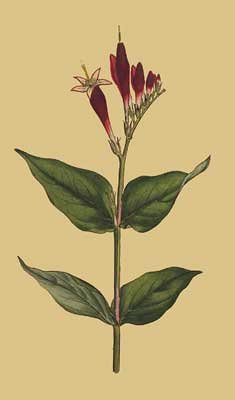
Spigelia Marilandica
This plant, not less celebrated for its superior efficacy in destroying worms, than admired for its beauty, is a native of the warmer parts of North America, the older Botanists, and even Linnaeus, at one time considered it as a honeysuckle, but he has now made a new genus of it, which he has named in honour of Spigelius, a Botanist of considerable note, author of the Ifagog. in yem herbar. published at Leyden in 1633.This plant is not easily propagated in England, for the roots make but slow increase, so that the plant is not very common in the English Gardens at present, for although it is so hardy as to endure the cold of our ordinary winters in the open air, yet as it does not ripen seeds, the only way of propagating it is by parting of the roots, and as these do not make much increase by offsets, so the plants are scarce, it delights in a moist soil, and must not be often transplanted. Millers Dict.The scarcity of this plant, even now, is a proof of the justness of Mr. Millers observation, it is in fact a very shy plant, and scarcely to be kept in this country but by frequent importation.It flowers in June and July.

 Glycine Rubicunda
 Mesembryanthemum Aureum
 Hyacinthus Racemosus
 Alyssum Utriculatum
 Ranunculus Gramineus
 Coronilla Valentina
 Campanula Speculum
 Ornithogalum Nutans
 Clematis Integrifolia
 Primula Marginata
 Adonis Vernalis
 Sedum Populifolium
 Test your English Language
  Benefits of Curry Leaves
 Precautions while using Electrical Equipment
 World Adventures
 Play Long Jump Games Ways to Get Happy The Most Beautiful Views in the World Batsmen Who Slapped Most Sixes in ODI Cricket Natural Wonders of the World
 World Architecture
 The Most Romantic Train Journeys Cutting Edge Technologies Soon to be Used in Cars
 Weird Places On Earth Unhealthy Habits That Will Cost You Dearly
 What to Eat in Gujarat Amazing Cars
 Prime Minister Of India Problems Only 00s Girls Will Understand
 Promise Day