


Fritillaria Imperialis
Flowers



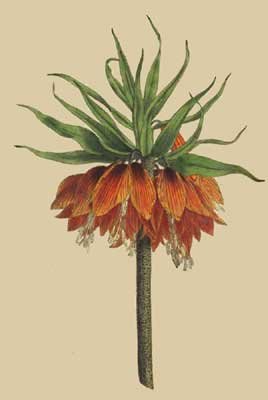
Fritillaria Imperialis
The Crown Imperial, a native of the East, most probably of Persia, was introduced according to Dodon?us, into the gardens of the emperor and some of the nobility at Vienna in 1576, it appears to have been cultivated here as early as 1596 both Gerard and Parkinson describe it minutely, the latter on account of its stately beautifulness, gives it the first place in his garden of delight.It flowers usually in the beginning of April, the whole plant sends forth a strong unpleasant smell, compared by most writers to that of a fox, perceptible when you approach it, to this effluvia Parkinson endeavours to reconcile us by saying that it is not unwholesome, it is so disagreeable however, that few choose to have many of these plants, or those in the most frequented parts of their gardens, yet it ought not to be proscribed, for independent of its beauty, there is much in it to admire, and especially its singular Nectaria, which in the form of a white glandular excavation decorate the base of each petal, in these usually stands a drop of clear nectareous juice, the peduncle or flower stalk which bends downwards when the plant is in flower, becomes upright as the seed ripens.
Of this plant, as of all others which have long been objects of culture, there are many varieties, those most generally cultivated in our gardens are the common orange flowered single and double, yellow single and double, gold striped leaved, and silver striped leaved, the Dutch in their catalogues enumerate thirteen varieties.Luxuriant plants will sometimes produce a second and even a third whorl or crown of flowers, and the flat stalked ones which are monsters, have been known to produce seventy two blossoms, but none of these are found to be constant.The Crown Imperial, though a native of a much warmer climate than ours, is a hardy bulb, and not very nice in regard to soil, succeeds best in such as is stiffish, enriched with manure, and placed in a sheltered situation.Is propagated by offsets, which are produced in tolerable abundance.

 Viola Pedata
 Lotus Tetragonolobus
 Hibiscus Syriacus
 Primula Marginata
 Mesembryanthemum Aureum
 Epidendrum Cochleatum
 Monsonia speciosa
 Fumaria Solida
 Erythronium Dens Canis Dogs Tooth or Dogs Tooth Violet
 Lopezia Racemosa
 Alyssum Halimifolium
 Gladiolus Tristis
 Test your English Language
  Stunts Mania
 What to Eat in Rajsthan
 Most Terrifying Civilizations In the History of the World Best Marwari Mehndi Designs
 Worlds Most Beautiful National Parks Most Well Travelled Peoples In The World
 Benefits of Saffron
 What to Eat in Sikkim
 Mahatma Gandhi Unreal Travel Destinations in Europe Billiards Pool Game for Beginners
 Cinderella
 Major Wars Of 20th Century Most Unique Bridges In The World Fashion Designers of all time Most Obscure Sports In The World Most Photogenic and breathtaking places in the world Most Player of the Match Award Winners in ODIs